
FAQ
Main Unit
Q1 : What is the system configuration ?
A1 : The system consists of the main unit (LX-1000) and expansion units.
Q2 : What is the maximum number of channels that can be recorded ?
A2 : With a configuration of one main unit (LX-1000) and three expansion units (AU-LX1000EPIO), up to 64 channels can be recorded.
Q3 : What types of storage media are supported, and what is the storage capacity ?
A3 : Supported media: SDHC and SDXC cards. Storage capacity ranges from 8GB to 128GB.
Q4 : What media has been verified for compatibility ?
A4 : A list of verified media is available on our website.
Q5 : Can multiple main units be synchronized ?
A5 : Up to four units can be synchronized.
Q6 : What if I want to measure more than 64 channels ?
A6 : By synchronizing four units, you can record up to 256 channels.
Q7 : What if I want to measure in a quiet environment ?
A7 : Fanless operation is possible for up to 32 channels.
Q8 : What happens in the case of a short power interruption ?
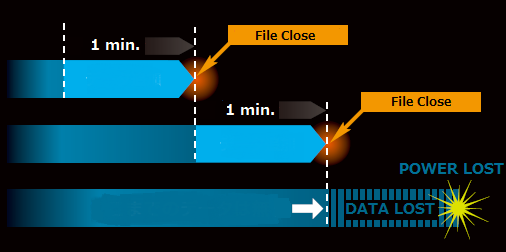
A8 : The LX-1000 has a data protection feature to prevent data loss due to unexpected power failure. Files are closed and saved every 60sec.
Periodic File Closure
LX-1000 closes data files every 60 seconds while recording.
Therefore, even if an unexpected power failure occurs during recording, most of recorded data is saved.
The maximum data loss possible is the last 60sec.
Q9 : Can configuration settings be saved to the unit ?
A9 : The most recent configuration settings are saved to the unit.
Additionally, to save multiple configuration settings, you can save them as files to a recording medium (SDHC/SDXC card).
Q10 : Is pulse input supported ?
A10 : Yes, it is supported.
Amplifiers Unit
Q1 : What types of amplifiers are available ?
A1 : There are four types: analog input (switchable between DC, AC, and IEPE), analog output, CAN, and strain.
Q2 : Is it possible to enable or disable recording for each amplifier ?
A2 : Yes, it is possible.
Q3 : What is IEPE ?
A3 : IEPE stands for “Integrated Electronics Piezo-Electric” and refers to a voltage-output piezoelectric system.
The terms listed below are proprietary names used by each manufacturer.
PCB: ICP
Brüel & Kjær: Delta Tron
Wndevco: Iso Tron
Kistler: Piezotron
The names listed are trademarks or registered trademarks of their respective companies.
Q4 : What is the TEDS version ?
A4 : It supports Ver. 1.0.
Adding Channels After Purchase
Q1 : Is it possible to add additional amplifiers after purchase ?
A1 : Yes, it is possible.
Q2 : Can the amplifier configuration be changed by the user ?
A2 : Yes, it can.
Software
Q1 : Can the LX-1000 be used via a computer ?
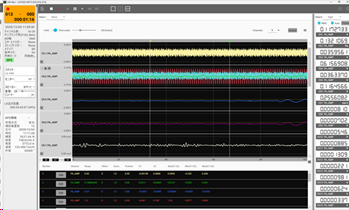
A1 : Yes. LXK Navi is navigation software for the LX-1000 that allows you to configure all operating parameters, and it can be downloaded from our website.
Q2 : Does LXK Navi support both 32-bit and 64-bit operating systems ?
A2 : It supports 64-bit operating systems.
Q3 : Which Windows OS versions are compatible with WX9K Navi ?
A3 : Windows 10 (64-bit) and Windows 11.
Q4 : What are the minimum system requirements for LXK Navi on a PC ?
A4 : CPU: Intel® Core™ i5 3.0GHz, 4 cores or more
Q5 : Please recommend software that allows me to record and perform FFT analysis on vibration and acoustic data while controlling the LX-1000.
A5 : The T-RecX / RTA-VU2 software is designed to control the LX-1000 in real time and analyze recorded data.
https://datarecorder.teac.com/software/t-recx-basic/